Short videos from Platinum Electrical Engineering that explain software defined automation in plain terms. Software defined automation separates control software from the hardware it runs on, and IEC 61499 is the international standard that makes it possible. There are 38 videos in three groups. The first group is for engineers and explains IEC 61499, the standard for event driven, distributed automation and the basis of Schneider Electric EcoStruxure Automation Expert. It comes in three sets of six: Foundations, Intermediate and Advanced. The second group, What it means for your plant, gives advice for key stakeholders and shows how the standard applies to industry verticals, also in three sets of six. The third group is two videos on Platinum SpecWorks, our tool for writing a clear IEC 61499 request for proposal, filmed in the live application. Ask us for access to SpecWorks. Most videos run for two to three minutes and each one builds on the one before, so we suggest you watch each group in order. You can also find them all on our YouTube channel.
Foundations
What IEC 61499 is, how it differs from traditional PLC programming, and how to get started on a real site.
 Watch on YouTube
Foundations, episode 1
What actually changes
About 3 minutes
A plain English introduction to the two international standards used to program industrial control systems, IEC 61131-3 and IEC 61499. It shows how each one is laid out, what changes when you move to IEC 61499, and why that change is easier than many engineers expect.
 Watch on YouTube
Foundations, episode 2
Events and data
About 3 minutes
Every IEC 61499 diagram has two kinds of connection. Events say when something should happen and data says what value to use. This episode shows how they work together each time a block runs.
What this episode covers
- Event connections and data connections
- How an event takes a snapshot of its data
- The four common event names: INIT, INITO, REQ and CNF
- One event, one run, and how to follow the order of execution
- Running logic on a fixed cycle with E_CYCLE
- A clean start for every block
 Watch on YouTube
Foundations, episode 3
Three kinds of block
About 3 minutes
An IEC 61499 application is built from three kinds of function block. This episode explains what each one is for and how they fit together.
What this episode covers
- Basic blocks: where the logic lives, using a state chart and Structured Text
- Composite blocks: blocks built from other blocks
- Service blocks: the link to inputs, outputs and the network
- Types and instances: improve the master copy once and every use is improved
- Building upwards from motors to sections, lines and whole plants
 Watch on YouTube
Foundations, episode 4
From blocks to objects
About 3 minutes
A real motor needs more than control logic. It also needs operator graphics, alarms and field signals. This episode shows how all of these can be packaged into one reusable object.
What this episode covers
- Composite automation types (CATs): logic, field connections and graphics in one object
- Adapters: one connection instead of many
- Libraries of proven objects that any project can reuse
- Testing objects on a soft controller before any hardware arrives
 Watch on YouTube
Foundations, episode 5
One application, many devices
About 3 minutes
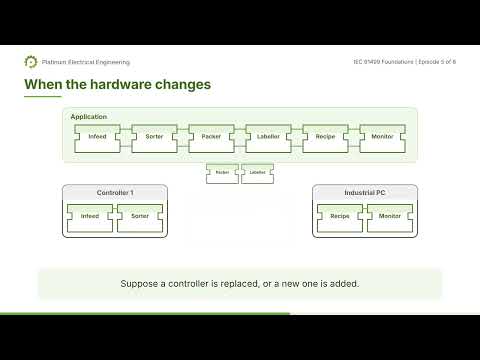
IEC 61499 lets you design the process first and choose the hardware second. This episode explains how one application is spread across several controllers.
What this episode covers
- The application view and the system view
- Devices and resources
- Mapping blocks to devices
- How the tool builds the communication between devices for you
- Changing hardware without rewriting tested logic
 Watch on YouTube
Foundations, episode 6
Your first project
About 3 minutes
You do not need a new plant to start with IEC 61499. This episode covers how to begin on a real site, alongside the PLCs you already have.
What this episode covers
- Adding a 61499 controller next to existing PLCs, using Modbus and OPC UA
- Choosing a small, useful, low risk first project
- People and skills: what carries across and what is new
- Deciding how you will measure success
- Crawl, walk, run: a practical path to adoption
Intermediate
One worked example, a small pumping station, taken from the first block through to testing and commissioning.
 Watch on YouTube
Intermediate, episode 1
Designing a block
About 3 minutes
Every application starts with one good block. Using a small pumping station as the example, this episode designs a block to control one pump, step by step.
What this episode covers
- Deciding the block interface first
- Choosing events and linking each one to its data
- Drawing the states: stopped, starting, running and faulted
- Adding short pieces of Structured Text logic to each state
- Testing the block on its own
 Watch on YouTube
Intermediate, episode 2
Timing and sequence
About 3 minutes
Real plant needs delays, checks and things that happen in turn. This episode shows how timing and sequence are built from a small set of standard event blocks.
What this episode covers
- The E_DELAY block and a pump start check
- Switch, merge and split blocks for steering events
- Sharing duty between two pumps
- Turning a level reading into events
 Watch on YouTube
Intermediate, episode 3
Building the station
About 3 minutes
This episode brings the pump block, start check and duty sharing together into one object for the whole pumping station.
What this episode covers
- Wrapping the pump and its start check into a composite block
- Using an adapter so each pump connects with a single line
- Writing the station logic as a state chart
- Building the station in three simple layers
 Watch on YouTube
Intermediate, episode 4
When things go wrong
About 3 minutes
Real plant trips, jams and loses signals. This episode shows how to design the pumping station so that it fails safely and tells someone.
What this episode covers
- Equipment faults, bad signals and lost communication
- Handling a pump trip and starting the standby pump
- Alarms that belong to the object
- Deciding the safe state of every output
- Testing each failure at the desk
 Watch on YouTube
Intermediate, episode 5
Across the network
About 3 minutes
This episode spreads the pumping station across two devices and connects it to the control room, while keeping control close to the plant.
What this episode covers
- Mapping control to the controller nearest the plant
- What travels on the network link, and when
- What happens when the link is lost
- Connecting to SCADA over OPC UA and to an older PLC over Modbus
 Watch on YouTube
Intermediate, episode 6
Test, commission, change
About 3 minutes
The final episode proves the pumping station, puts it to work on site and keeps it working as the site changes.
What this episode covers
- Testing against a software model of the well
- Recording test evidence on a soft controller
- Shorter, easier commissioning on site
- Handling a change request without touching other stations
- Keeping what you have built in a versioned library
Advanced
What changes when one station becomes twenty and one engineer becomes a team: structure, timing, communication, libraries, migration and long term care.
 Watch on YouTube
Advanced, episode 1
Structuring a large application
About 3 minutes
When one station becomes twenty and one engineer becomes a team, structure is what keeps an application readable.
What this episode covers
- Shaping the application like the plant: area, unit, device
- Giving each layer one job
- Agreeing the interfaces first, using adapters
- Naming things the same way everywhere
- Keeping every diagram small enough to read
 Watch on YouTube
Advanced, episode 2
Execution in depth
About 3 minutes
What really happens inside a controller when many events arrive at once, and how to keep response times predictable.
What this episode covers
- One block runs at a time, and events queue
- Following a chain to find its response time
- Avoiding event loops and event storms
- Where a fixed cycle still belongs
- Measuring load and response time, not guessing
 Watch on YouTube
Advanced, episode 3
Communication by design
About 3 minutes
With many stations, the network becomes part of the design. This episode covers how to decide what travels, how often, and what happens when it does not.
What this episode covers
- Publish and subscribe, or client and server
- Sending on change, with a heartbeat
- Giving every value a quality
- Offering whole objects to SCADA over OPC UA
- Planning the network like the rest of the plant
 Watch on YouTube
Advanced, episode 4
Libraries and versions
About 3 minutes
Reuse is the main reason to choose IEC 61499. This episode explains how to look after a library that many projects depend on.
What this episode covers
- One named owner for every type
- Version numbers with a clear meaning
- Testing and releasing each version like a small product
- Letting each project choose when to update
 Watch on YouTube
Advanced, episode 5
Migrating existing plant
About 3 minutes
Most projects start with a working site, not an empty one. This episode shows how to bring IEC 61499 in one step at a time.
What this episode covers
- Leaving alone what already works
- Wrapping old PLCs behind a standard object
- Moving one area at a time, with a way back
- What to do with existing code
- Bringing maintenance staff with you
 Watch on YouTube
Advanced, episode 6
Security and the long term
About 3 minutes
A control system runs for twenty years. This final episode covers what to put in place so it stays secure, supported and understood.
What this episode covers
- Security by design, working to IEC 62443
- Version control and tested backups
- Diagnostics built into every object
- Changing hardware without rewriting the application
- Handing over more than software
Advice for key stakeholders: the benefits
Six benefits of IEC 61499 in business terms, for plant managers, operations directors, asset owners and procurement teams. No programming knowledge is needed.
 Play video
What it means for your plant, episode 1
Software that outlives the hardware
About 2 minutes
Every control system has two parts: the hardware you can see, and the software that makes it work. In most plants today, the two are tied together.
What this episode covers
- Your engineering is protected
- A hardware replacement becomes a planned, smaller job
- You have a choice
- That choice changes the conversation when you buy
- What to be clear about before you start
 Play video
What it means for your plant, episode 2
Stop starting from scratch
About 2 minutes
Most plants are built from the same things, many times over: pumps, valves, motors, conveyors. Yet the control software for each one is often written again on every project.
What this episode covers
- Projects are delivered faster, because most of the work is already done and already proven
- Quality goes up, because every site runs the same tested object
- Your operators and technicians see the same screens and the same behaviour on every site
- An improvement made once can be rolled out everywhere, in a controlled way
- What to be clear about before you start
 Play video
What it means for your plant, episode 3
Find the faults before site
About 2 minutes
Commissioning is where control projects most often run late. It is also the most expensive place to find a fault.
What this episode covers
- Faults are found when they are cheap to fix
- You can watch your plant run, and agree how it should behave, before anything is installed
- Operators can be trained before the plant exists
- Time on site becomes shorter and easier to predict
- What to be clear about before you start
 Play video
What it means for your plant, episode 4
Change without the rewrite
About 2 minutes
No plant stays as it was designed. Products change, demand grows, and equipment is added.
What this episode covers
- Changes cost less, because the work is limited to what is new
- Changes carry less risk, because proven parts are left alone
- Testing is focused on the change, not on the whole plant
- The plant can follow the business, without waiting for the next big upgrade
- What to be clear about before you start
 Play video
What it means for your plant, episode 5
Data you can use
About 2 minutes
Every plant produces data. Far fewer plants make good use of it. The reason is usually not the business systems. It is how the data leaves the controller.
What this episode covers
- New screens and reports are quicker to build, because the data is already organised
- Sites can be compared fairly, because they all report in the same way
- Maintenance can be planned from real running hours and real fault history
- When you add a new system later, the data is ready for it
- What to be clear about before you start
 Play video
What it means for your plant, episode 6
Modernise without stopping
About 2 minutes
For most sites, the question is not whether to modernise. It is how to do it without stopping production. A complete replacement is expensive and risky, and it needs a long shutdown.
What this episode covers
- Production keeps running, because no single step is large
- Spending is spread over several years, and each step delivers a benefit of its own
- Your team learns the new system on a small area first
- You can start where the need is greatest: the oldest hardware, or the next extension
- What to be clear about before you start
Advice for key stakeholders: buying and planning
How to build the business case, what to ask a supplier, what to write into a specification, where to start, and how to manage people and risk.
 Play video
What it means for your plant, episode 7
Building the business case
About 2 minutes
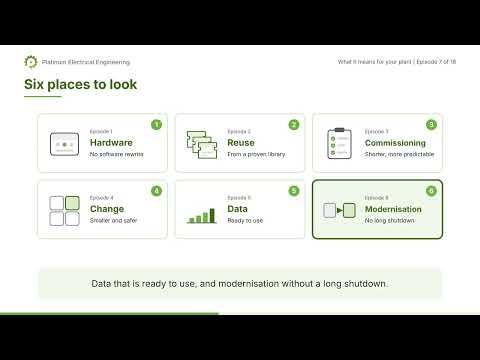
The first six episodes covered six benefits of IEC 61499. Each one stands on its own. Together, they change what a control system costs over its life.
What this episode covers
- Look at the whole life
- Six places to look
- Use your own numbers
- Be honest about the costs
- Start with one project
 Play video
What it means for your plant, episode 8
Questions to ask your supplier
About 2 minutes
Once you are interested in IEC 61499, the next step is to talk to suppliers. Many will say they can deliver it. Fewer have done so.
What this episode covers
- Ask what they have delivered
- Ask about their library
- Ask what you will own
- Ask how it will be tested
 Play video
What it means for your plant, episode 9
Writing it into the specification
About 2 minutes
A specification decides what you receive. Writing "must comply with IEC 61499" is not enough. A poor design can comply.
What this episode covers
- Ask for structure
- Keep software and hardware apart
- Ask for proof before site
- Say what is handed over
 Play video
What it means for your plant, episode 10
Choosing the first project
About 2 minutes
The first project sets the tone for everything that follows. Choose well, and the results make the case for you.
What this episode covers
- What a good first project looks like
- What to avoid
- Decide how you will measure it
- Plan the second project
 Play video
What it means for your plant, episode 11
People and skills
About 2 minutes
New technology succeeds or fails with the people who use it. IEC 61499 asks them to think a little differently, not to start again.
What this episode covers
- Three groups, three needs
- What carries over
- How people learn it best
- Where support comes from
 Play video
What it means for your plant, episode 12
Managing the risks
About 2 minutes
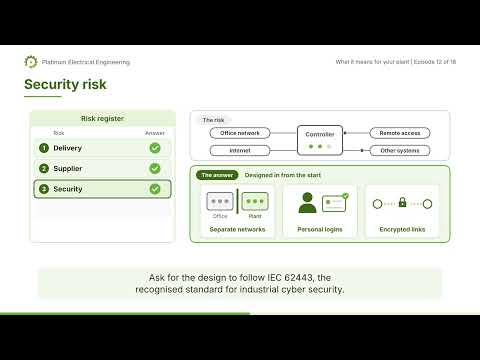
Every change carries risk, and a board will rightly ask about it. The risks with IEC 61499 are known, and each has a practical answer.
What this episode covers
- Delivery risk
- Supplier risk
- Security risk
- People risk
- The risk of doing nothing
Applied to industry verticals
Where IEC 61499 fits in water, food and drink, logistics and baggage handling, energy and data centres, manufacturing and process plant.
 Play video
What it means for your plant, episode 13
Water and wastewater
About 2 minutes
A water company runs hundreds of sites: pumping stations, treatment works and reservoirs. Most were built at different times, by different suppliers, with different controllers.
What this episode covers
- Reuse: one tested pumping station design, used at every site
- Hardware choice: the same application on a small or a large controller
- Consistent data from every site
- Where to start
- What to be clear about
 Play video
What it means for your plant, episode 14
Food and drink
About 2 minutes
A food or drink plant rarely makes the same thing for long. New products, new pack sizes and new customers arrive every year.
What this episode covers
- A line that can be rearranged without rewriting it
- One application coordinating machines from different makers
- Records that support traceability
- Where to start
- What to be clear about
 Play video
What it means for your plant, episode 15
Logistics and baggage handling
About 2 minutes
A baggage system or a distribution centre is a long chain of conveyors, sorters and scanners. It has to run every day, and it rarely stays the same size.
What this episode covers
- A tested conveyor object, used again and again
- Testing the whole flow on a model before switch-on
- Control close to the equipment, so one fault does not stop the system
- Where to start
- What to be clear about
 Play video
What it means for your plant, episode 16
Energy and data centres
About 2 minutes
A data centre, a hospital or an energy site has one rule: the power and the cooling must not stop. Yet these sites are extended and upgraded all the time.
What this episode covers
- A tested block for one hall or unit, then repeated
- One application coordinating equipment from different makers
- Rehearsing a changeover to standby power on a model
- Consistent information for energy reporting
- Where to start
- What to be clear about
 Play video
What it means for your plant, episode 17
Manufacturing
About 2 minutes
A factory is a collection of machines, cells and lines, bought over many years. Each works well on its own. Getting them to work together is the hard part.
What this episode covers
- One application coordinating the cell
- Rearranging a cell for a new product
- Linking in older machines and keeping them
- A clear structure that is easier to hand on
- Where to start
- What to be clear about
 Play video
What it means for your plant, episode 18
Process plant
About 2 minutes
Process plants run around the clock, in established industries and in new ones. This episode draws on a real project from our own work. It was a large process plant, built on a remote site and expanded in stages.
What this episode covers
- A complete, decentralised control system delivered by Platinum
- Repeated units as tested objects
- Reusing the same objects when the site expands
- Changing one area while the rest keeps running
- What it shows
- What to be clear about
Platinum SpecWorks: the RFP generator
SpecWorks is our tool for writing a clear IEC 61499 request for proposal, so that every bidder answers the same questions. These two videos are filmed in the live application. You can use it yourself, or we can run it with you as a service. Find out more about Platinum SpecWorks.
 Play video
Platinum SpecWorks, part 1
Writing a clear RFP
About 3 minutes
A walkthrough of the tool, from starting a project to exporting the finished document.
What it covers
- Starting a project and choosing your sector
- The guided interview
- Help notes, Ask AI and Draft with AI
- Sharing and comments for the whole team
- Validate, preview and export to Word or PDF
- What is next on the roadmap
 Play video
Platinum SpecWorks, part 2
The twelve chapters
Under 3 minutes
What each chapter of the RFP does, and why it is there.
What it covers
- What you are buying: chapters 1 to 3
- How it should be built: chapters 4 to 6
- How you stay protected: chapters 7 to 9
- How you choose and take delivery: chapters 10 to 12
Want to see how this applies to your plant or project?
Get in touch and we will talk it through.